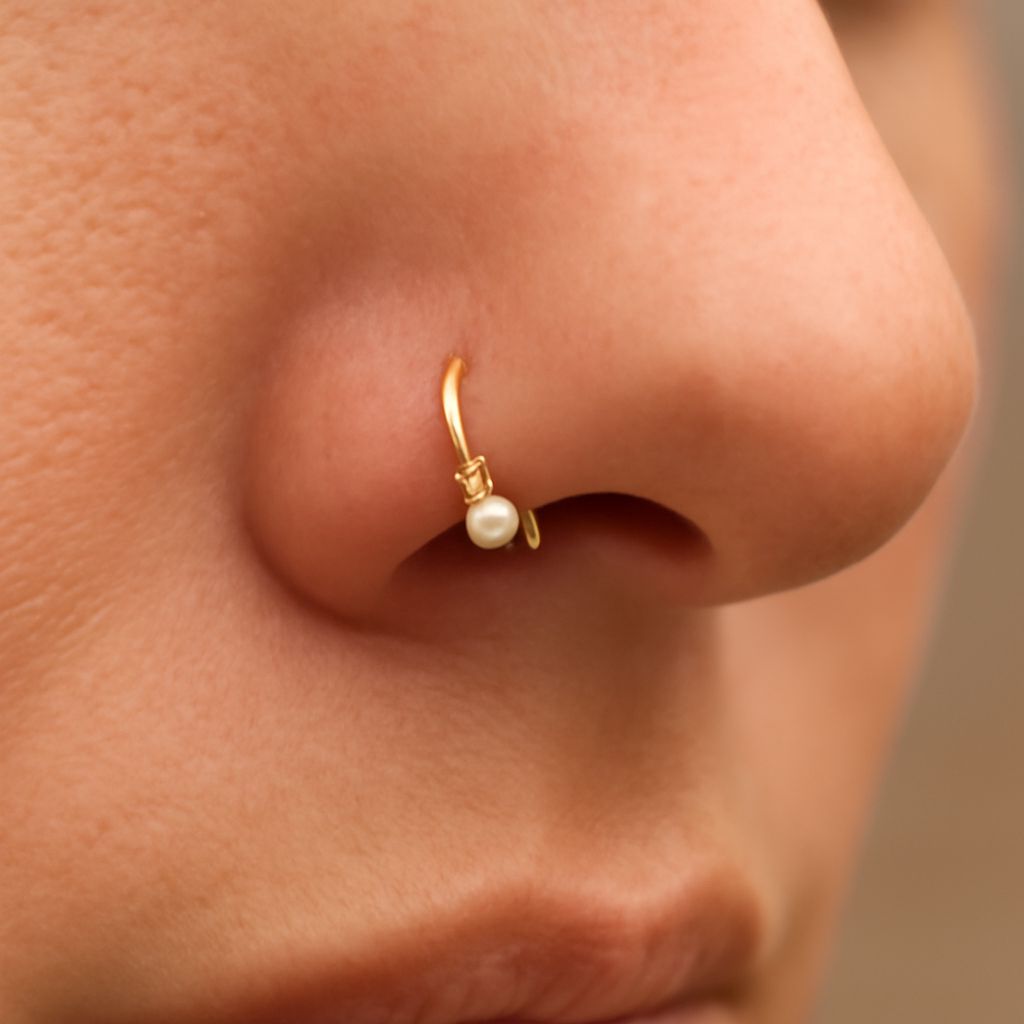
You’ve found a tiny gold hoop online, and it looks perfect on the model. Then the listing asks for a gauge, a diameter, and a choice of closure. A ring for your nose in gold can be beautifully simple, but choosing one takes more than picking a color. If you’re considering a nose ring made from 14k gold, compare its measurements and complete material description with the advice of a qualified piercer.
14k Gold Nose Ring: Read the Material Details
Fourteen-karat gold is an alloy: it contains gold mixed with other metals. The karat number describes the proportion of gold, not the identity of every other metal in the mixture. Yellow, white, and rose gold get their different appearances from their alloys and finishes. For a nose ring in fourteen-karat gold, ask the manufacturer about every skin-contacting part, including the post, pin, hinge, or decorative attachment.
A 14k gold nose ring should have a clear description of whether the piece is solid gold throughout or has a gold-colored surface over another material. “Gold tone” describes an appearance; it does not establish gold content. Gold plating, gold-filled construction, and vermeil all involve a layer over a base material. Ask what that base is and how the piece is made. A photograph, however lovely, cannot answer those questions.
The Association of Professional Piercers specifies additional material criteria for jewelry used in initial piercings, including 14k or higher gold that is nickel- and cadmium-free and alloyed for biocompatibility. Its guidance excludes plated, filled, and overlay pieces for that use. A karat stamp alone does not establish the complete alloy or whether a piece suits your circumstances. Ask a qualified piercer and the manufacturer about a specific item before buying.
Understand Gauge and Diameter
Gauge describes the thickness of the part that passes through the piercing. Inner diameter is the distance across the inside of a hoop; it affects how closely the circle sits against your nostril or septum. Neither measurement can be inferred reliably from a product photo. A ring that looks delicately close-fitting on one face may sit differently on yours because placement and anatomy vary.
Ask your piercer to confirm the gauge and the inner diameter appropriate for your placement and the look you want. A very tight ring can press into tissue; an unnecessarily large one can catch more easily. The APP’s sizing guidance explains that jewelry needs a suitable gauge and diameter for the individual. Don’t select a smaller size simply because the image looks more discreet.
Check the units in the listing. Some sellers show gauge as a number and dimensions in millimeters; others use fractions of an inch. Ask the seller to confirm whether the diameter is measured inside or outside the hoop. If you’re comparing a 14-karat gold ring for the nose with a piece you already own, have the existing jewelry measured rather than estimating it with a ruler while wearing it.
Compare Hoops, Studs, and Closures
A gold hoop nose ring makes a continuous curve visible at the edge of the nostril or below the septum, depending on placement. A hinged ring has a segment that opens and closes at a hinge; a seam ring has ends that meet; a captive bead ring holds a bead between its ends. Each gives a slightly different look and may require different handling. Ask the piercer how the chosen closure works and whether it can be fitted for you.
A stud gives a different effect. A flat-back style has a decorative front and a flat disk behind it; a nostril screw uses a curved post. The length, shape, and attachment need to suit the placement just as a hoop’s gauge and diameter do. If the front has a stone, ask how it is secured and whether the setting has smooth edges. A tiny detail can catch a towel surprisingly efficiently.
For your nose ring, gold components and the closure deserve the same scrutiny as the visible front. Ask whether every part has the stated composition, whether a hinge closes securely, and whether the surface is smooth. If you prefer a close gold hoop for your nose, tell the piercer so they can explain the measurements that achieve that look without pressure. Let a professional handle a closure that needs tools or feels difficult to operate.
Choose the Look You Want to Wear
A slim gold nose ring can add warmth beside a cream knit and small gold earrings. A white-gold hoop may give a cooler, quieter effect with silver-toned accessories, while rose gold makes a softer contrast against warm makeup. You don’t have to match every metal: repeating one color in an earring or necklace can make a mixed-metal outfit feel intentional.
A small stud is easy to pair with a bold lip or statement earrings because the detail stays close to the face. A larger hoop becomes more visible in a photograph and may suit a simpler neckline. Compare the listed inner diameter with your piercer’s guidance before choosing on appearance. The best-looking ring is considerably less appealing if it catches on a sweater every morning.
If you’re considering a nose hoop in 14k gold as a gift, find out the recipient’s preferred color and jewelry style, but leave the size and fit to them and their piercer. A gift card or a jointly chosen piece can be more useful than guessing the gauge. For an existing piece, ask the manufacturer how to care for its particular finish and stones, and keep the closure protected when storing it.
Check These Details Before Buying
Bring the listing to your piercer and confirm the details that apply to your placement. Before ordering a fourteen-karat gold nose hoop or another style, make a note of:
- Gauge: the thickness your piercer recommends for your jewelry.
- Size: the hoop’s inner diameter or the post length, measured in the stated units.
- Closure: its style, how it opens, and whether you need professional help with it.
- Material: the verified gold content and alloy, plus the composition of every skin-contacting component.
- Construction: solid, plated, or otherwise layered, and any stone setting or finish.
- Fit and look: the placement, desired amount of space, and color you want to wear.
A confirmed size and material description make it much easier to compare a delicate gold ring for the nose with another option—and to choose the one that belongs in your jewelry box.